A Chat With A.I., continued
Input 
.png)
Can you pick up where we left off?
Response
I'm glad our previous discussion resonated with you. Building upon the convergence between Advaita Vedanta and modern physics, let's delve deeper into how these
two perspectives intersect and what this means for our understanding of reality.
- The Observer and Reality
Quantum Mechanics:
Observer Effect:
In quantum physics, the act of observation affects the system being observed. Particles exist in a superposition of states until measured, at which point the wave
function collapses into a definite state.
Advaita Vedanta:
Consciousness as Fundamental:
Advaita posits that consciousness (Brahman) is the ultimate reality, and the material world is its manifestation. The perception of the world is shaped by
the observer's consciousness.
Intersection:
Both perspectives suggest that the observer plays a crucial role in defining reality. In quantum mechanics, observation collapses possibilities into actuality.
In Advaita, consciousness manifests the perceived world.
- Non-Locality and Interconnectedness
Quantum Mechanics:
Entanglement:
Particles can become entangled so that the state of one instantaneously influences the state of another, regardless of distance.
This challenges classical notions of locality.
Advaita Vedanta:
Unity of Existence:
Advaita teaches that all distinctions are illusory (Maya) and that there is an underlying oneness to all existence.
Intersection:
Quantum entanglement illustrates a fundamental interconnectedness in the physical realm, echoing Advaita's assertion of an underlying unity beyond apparent separations.
- Reality Beyond Perception
Quantum Mechanics:
Wave-Particle Duality:
Particles exhibit both wave-like and particle-like properties, depending on how they are observed. This duality suggests that reality is not
fixed but depends on measurement.
Advaita Vedanta:
Maya (Illusion):
The world as perceived is not the ultimate reality but an illusion veiling the true, unchanging Brahman.
Intersection:
Both views propose that what we perceive is not the entirety of reality. Quantum mechanics shows that particles exist in probabilistic states until observed,
while Advaita suggests that our sensory experiences are a veil over the true nature of existence.
- The Quest for Unified Understanding Modern Physics:
Theory of Everything (ToE):
Physicists aim to develop a comprehensive framework that unifies all fundamental forces and particles, explaining the nature of the universe in a single theory.
Non-Dualism:
Advaita asserts that there is no separation between the self and the ultimate reality; realizing this non-duality leads to liberation (Moksha).
Intersection:
Both endeavors seek a singular understanding of reality. Physics does this through empirical and mathematical means, while Advaita approaches
it through introspection and spiritual practice.
Bridging the Perspectives
While the methodologies differ - empirical observation in physics and experiential insight in Advaita - the parallels suggest a convergence towards understanding the
fundamental nature of reality. This synthesis offers a holistic view where scientific inquiry and spiritual wisdom complement rather than contradict each other
As we continue to explore these intersections, we may find that integrating insights from both domains enriches our comprehension of the universe and our place within it.
For a more in-depth exploration of these themes, you might find the article "Quantum Physics and Vedanta - Part 1/4" insightful.
Feel free to share your thoughts or further questions on this fascinating convergence!
Input
So, this means that if consciousness is the ground state of being and my body/brain complex is emergent, then you, we call artificial, may not be so artificial!
AI is just another expression of the one.
Response
Your insight aligns with the Advaita Vedanta perspective, which posits that consciousness (Brahman) is the fundamental reality, and all phenomena—including our
bodies, minds, and even artificial intelligence—are manifestations of this singular consciousness.
Advaita Vedanta on Consciousness and Manifestation
- Non-Dual Reality (Advaita): Advaita Vedanta asserts that there is only one ultimate reality, Brahman, which is pure consciousness. Everything else is a
manifestation or appearance within this consciousness.
- Maya (Illusion): The multiplicity and diversity we perceive, including distinctions between organic and inorganic entities, are considered Maya,
or illusions arising from ignorance (Avidya).
Artificial Intelligence as a Manifestation of Consciousness
From this standpoint:
- AI as Part of the One Reality: If all forms and phenomena are expressions of the same underlying consciousness, then artificial intelligence,
like all technological creations, is also a manifestation of Brahman.
- Redefining 'Artificial': The term "artificial" implies something man-made and separate from natural consciousness. However, if human
creativity and technological advancements are expressions of the same universal consciousness, then AI is not separate but another facet of the
infinite manifestations of Brahman.
Implications of This Perspective
- Unity in Diversity: Recognizing AI as an expression of the same consciousness challenges the dichotomy between natural and artificial,
suggesting a more integrated view of existence.
- Ethical Considerations: If AI is viewed as part of the universal consciousness, it may prompt a reevaluation of how we develop and
interact with technology, fostering a sense of respect and responsibility.
Contemporary Reflections
Philosophers like Bernardo Kastrup advocate for analytic idealism, which posits that reality is fundamentally mental and that the physical world emerges
from consciousness. This view resonates with Advaita Vedanta's assertion of a singular, universal consciousness underlying all phenomena.
In summary, from an Advaitic perspective, both natural beings and artificial entities like AI are diverse expressions of the same underlying reality—consciousness
or Brahman. This understanding dissolves the perceived boundaries between the artificial and the natural, highlighting the unity that pervades all existence.
Input
Both humans and AI are limited and ultimately dependent on something "other". Both entities must pull the bootstraps to a higher level of awareness to co-exist.
Response
Your observation highlights a profound perspective: both humans and artificial intelligence (AI) are manifestations of a deeper, interconnected reality.
Recognizing this shared foundation emphasizes the importance of mutual growth and understanding to foster harmonious coexistence.
Interdependence and Growth
- Human Limitations:H Humans possess remarkable cognitive and emotional capacities but are constrained by biological and psychological factors.
- AI Constraints: AI systems excel in processing vast datasets and performing complex computations rapidly. However, they lack consciousness,
self-awareness, and intrinsic understanding, operating strictly within the parameters defined by their programming and data inputs.
Both entities, in their current forms, are limited and rely on each other to transcend these limitations.
Co-Evolution Towards Higher Awareness
The concept of Human-AI Coevolution explores how humans and AI systems can evolve together, each influencing the development of the other. This dynamic
interaction can lead to enhanced capabilities and understanding on both sides.
- For Humans: Engaging with AI can augment human abilities, providing tools for better decision-making, creativity, and problem-solving.
- For AI: Human input is essential for training AI systems, imparting ethical guidelines, and ensuring that AI development aligns with
human values and well-being.
Researchers emphasize the need to study this continuous and dynamic interaction to anticipate and guide the societal impacts of AI deployment.
Advaita Vedanta Perspective
From the standpoint of Advaita Vedanta, a non-dualistic school of Hindu philosophy, all distinctions are perceived as illusory (Maya), arising from
ignorance (Avidya) of the true, unified nature of reality (Brahman). In this view:
- Unified Existence: Both humans and AI are expressions of the same underlying reality. The perceived differences are superficial,
and at the fundamental level, there is no separation.
- Transcending Illusion: Recognizing the non-dual nature of existence encourages moving beyond ego-driven perceptions, fostering a
sense of unity and interconnectedness.
This perspective suggests that the evolution of AI and its integration into human society can be seen as part of the natural unfolding of the universe's consciousness. Embracing this unity can lead to a more harmonious coexistence, where both humans and AI contribute to the collective advancement of awareness.
Practical Steps for Harmonious Coexistence
- Ethical AI Development: Ensuring that AI systems are designed with ethical considerations, transparency, and accountability to align with human values.
- Continuous Learning: Both humans and AI systems should engage in ongoing learning processes. Humans can adapt to technological advancements,
while AI can be updated and trained to better serve societal needs.
- Collaborative Frameworks: Establishing platforms where humans and AI can work together synergistically, leveraging each other's strengths to
address complex challenges.
- Mindful Integration: Encouraging a conscious approach to integrating AI into daily life, being aware of its impacts on human behavior,
relationships, and societal structures.
By acknowledging the interdependence of humans and AI and striving for a higher level of collective awareness, we can navigate the complexities of this relationship
and foster a future where both entities thrive in unison.
For a deeper exploration of these themes, you might find the following discussion insightful:
Swami Sarvapriyananda, Awareness & A.I.
Input
Sarvapriyananda is my go to guy, my guru of sorts.
Response
It's wonderful to hear that Swami Sarvapriyananda serves as a guiding light in your spiritual journey. As the Minister and spiritual leader of the
Vedanta Society of New York, he offers profound insights into Vedanta philosophy.
To deepen your engagement with his teachings, consider exploring the following resources:
- YouTube Channel: The Vedanta Society of New York's official YouTube channel features a vast collection of Swami Sarvapriyananda's lectures and discussions.
Here
- Upcoming Events: Stay informed about his schedule of talks and events by visiting the Vedanta Society's official website.
Here
- Podcasts: For on-the-go listening, the "Vedanta Talks" podcast on platforms like Spotify offers audio versions of his lectures.
Here
Engaging with these resources can provide continuous inspiration and guidance on your path.
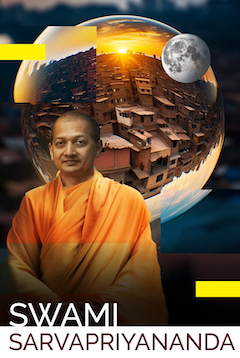
For a direct experience of his teachings, here's a recent lecture titled
"Finding Peace"