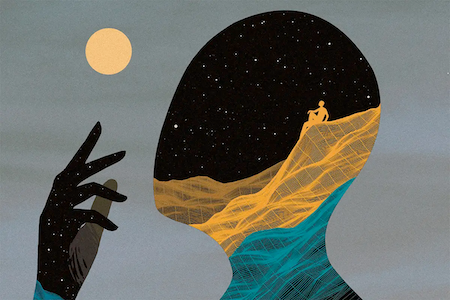
In the early 21st century, the standard practice to eliminate consciousness from
the scientific debate has been reversed, especially among younger scientists.
Defining what consciousness is still remains difficult, like seeing your head with
only your eyes. Below are some viewpoints being held by various philosophical/
scientific disciplines:
General Description
Consciousness is the state of being aware of and able to perceive one's
surroundings, thoughts, emotions, and existence. It encompasses subjective
experiences and the ability to reflect on those experiences. Consciousness is
often characterized by self-awareness, intentionality, and the capacity to
respond to stimuli.
In philosophy
It is a deeply debated concept involving questions about the nature of the mind,
the relationship between mental states and the physical brain, and the nature of
subjective experience (often referred to as qualia).
In neuroscience and psychology
Consciousness is typically studied as a function of the brain, involving
processes like attention, perception, memory, and decision-making. While its
exact nature remains a mystery, it is generally understood as the interplay
between biological processes and subjective experience.
In Vedanta
One of many schools of Hindu philosophy, consciousness (Chit) is
considered the ultimate reality and the essence of existence. It is not limited to
the mind or brain but is the foundational principle that pervades all beings and
the universe itself. According to Vedanta, consciousness is eternal, self-
luminous, and independent of the physical body or the material world.
Key points of the Vedantic definition of consciousness include:
In summary, in Vedanta, consciousness is not just awareness or thought - it is the infinite, non-dual reality that underlies all existence. From this point of reference solid, empirical science can be derived with repeatable results. With this reference point one can answer what existed before the theoretical Big Bang.